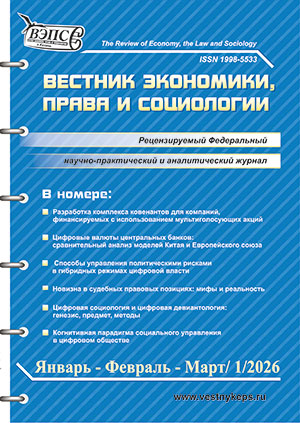
The peer-reviewed federal scientific, practical and analytical journal «The Review of Economy, the Law and Sociology» has been published since 2007. The journal is one of the leading Russian scientific publications that publishes the results of original theoretical and applied research on current issues in economics, law and sociology.
Registration certificate: PI No. FS77-89068 dated February 7, 2025 issued by the Federal Service for Supervision of Communications, Information Technology and Mass Media (Roskomnadzor).
ISSN (print): 1998-5533
Subscription index in «Press of Russia» – 43277.
The journal « The Review of Economy, the Law and Sociology» is included in the List of Leading Peer-Reviewed Scientific Journals and Publications in which the main scientific results of dissertations for academic degrees of Doctor and Candidate of Sciences should be published in the following scientific specialties and corresponding branches of science:
5.2. Economics
5.2.1 Economic Theory (Economic Sciences)
5.2.3 Regional and Sectoral Economy (Economic Sciences)
5.2.4 Finance (Economic Sciences)
5.2.5 World Economy (Economic Sciences)
5.2.6 Management (Economic Sciences)
5.2.7 State and Municipal Administration (Economic Sciences)
5.1. Law
5.1.1 Theoretical and Historical Legal Sciences (Legal Sciences)
5.1.2 Public Law (State Law) Sciences (Legal Sciences)
5.1.3 Private Law (Civil) Sciences (Legal Sciences)
5.1.4 Criminal Law Sciences (Legal Sciences)
5.1.5 International Law Sciences (Legal Sciences)
5.4. Sociology
5.4.1 Theory, Methodology and History of Sociology (Sociological Sciences)
5.4.2 Economic Sociology (Economic Sciences)
5.4.3 Demography (Economic Sciences)
5.4.4 Social Structure, Social Institutions and Processes (Sociological Sciences)
5.4.5 Political Sociology (Political Sciences)
5.4.6 Sociology of Culture (Sociological Sciences)
5.4.7 Sociology of Management (Sociological Sciences)
The journal is a scientific and practical publication designed for a wide audience, including: state and municipal authorities of the Russian Federation, scientists and specialized professionals in their fields, faculty members and students of educational institutions, business representatives from various sectors and expert community professionals.
The journal's geographic scope is quite extensive, with contributors coming from various regions. Our authors include:
- Researchers from different academic institutions;
- University professors representing educational establishments across Russia;
- Graduate students engaged in scientific research;
- Practitioners working in diverse fields;
- Specialists from all parts of Russia and neighboring countries.
This broad representation ensures a diverse range of perspectives and expertise in the journal's content.
Current issue
Экономика
The goal of this study was to develop a system of criteria and practical tools to support an informed choice of an architectural strategy for a recommender system based on its classifi by degree of personalization. To achieve this goal, we identifi and substantively characterized four classes of systems, developed a set of comparable evaluation parameters, and developed a design decision-making procedure.
The scientific significance of this study lies in its systematization of concepts regarding gradations of personalization and the substantiation of a set of seven interrelated criteria reflecting the key tradeoff between accuracy and complexity in this subject area. The practical value is determined by the development of a flowchart and checklist-tools applicable in the initial design stages and allowing for iterative refinement of the architecture as the service evolves.
The main results of the work indicate that none of the considered classes has an absolute advantage. The choice is determined by the specific project conditions, and the optimal development trajectory is a consistent progression from simple solutions to more complex ones as data accumulates. The novelty of the proposed approach lies in its shift from the problem of choosing a recommendation architecture to one of structured comparison based on explicit criteria.
In the context of increasing turbulence, increasing the level of risk of production and economic activities, and expanding the range of information resources, the relevance of studying management decision-making modeling processes is among the priorities of management theory and practice. The purpose of the article is to develop a system of modeling principles for managerial decision-making in the digital economy, as well as to develop an algorithm for adaptive modeling of the managerial decision-making process. The methodological base of the research includes methods of system analysis, visualization, econometric statistics and description. The work uses data from Rosstat and the National Research University Higher School of Economics.
The main research results include: a system of principles for modeling managerial decisions (information sufficiency, goal setting, verification, multiple choice, decomposition, parameterization); the developed algorithm for adaptive modeling; the concept of an interdisciplinary approach to modeling (bioinformatic, informational, cognitive modeling).
The scientific novelty lies in the development of an integrated approach to modeling management decisions that takes into account the specifics of the digital economy. The proposed algorithm can be used to specify and decompose control models in complex systems.
The practical significance of the work lies in the possibility of using the developed methodological approaches to improve the effectiveness of managerial decision-making in modern economic conditions.
The research contributes to the development of management theory and practice by offering new tools for adapting decision-making processes to the digital economy.
The article analyzes the process of preservation and adaptation for modern use of monuments of wooden architecture of St. Petersburg. The purpose of the study is to identify the current problems of the modern use of wooden architecture monuments in St. Petersburg in order to form recommendations on adapting their use in modern conditions. The main stages and features of the process of adaptation of monuments of wooden architecture are outlined. The actual problems of this process have been identified, both at the national level and at the level of St. Petersburg. The main state authorities that perform certain functions in the process of preserving and adapting monuments of wooden architecture are identified. The necessity of developing methodological recommendations aimed at optimizing the interdepartmental interaction of authorities in the process of preserving and adapting the monuments of wooden architecture of St. Petersburg is revealed.
The relevance of the research is determined by the need to ensure stable financing of the Russian military-industrial complex in the current geopolitical conditions. The issue of finding optimal sources of additional funding for the MIC while maintaining macroeconomic stability becomes particularly significant. The objective of the research is to assess the possibilities of increasing government spending on financing the MIC, including through the accumulation of public debt, and to analyze the potential economic impact of such financing. The scientific novelty of the research lies in substantiating the possibility of budget financing of defense expenditures in Russia through an increase in public debt. The practical significance of the work lies in substantiating the possibility of increasing public debt to finance the MIC, taking into account the calculation of debt security indicators. The proposed model for assessing the return of tax revenues allows predicting the effectiveness of additional public borrowing.
The main results of the research indicate the presence of a significant reserve for increasing Russia’s public debt while maintaining debt security indicators within acceptable limits. The developed model demonstrates that the return of funds to the budget through tax revenues (about 29 % of the funding volume) exceeds the costs of servicing the public debt.
This article presents the results of a study examining the affordability of comfortable housing for various population groups in Russia. The Perm Krai, a region where demand for mortgage and rental housing has grown dynamically over the past five years, was chosen as the baseline for this research. The authors argue that promising solutions for overcoming existing barriers must be developed on a solid theoretical and methodological foundation, incorporating cutting-edge advances from the scientific and expert communities. The authors' proposals substantiate the need to develop pilot strategies for promoting comfortable housing in the Perm Krai's urban agglomerations and key population centers. The core foundation of this strategy is proposed to be conceptual views on place marketing and branding, as well as the dominant needs of the creative class in the modern city, established in Russian economic science. Particular attention is focused on the development of rental housing in small towns and the development of conditions for the transition to high-quality long-term rentals. The methodological basis for the study is the economic-centric and geo-cultural approaches, which are widely used today in the science of public and municipal administration.
Thepurposeofthisworkistoformulateagoalsetting, identify the toolsandmechanismforimplementing the process of achieving the optimal level of economic security of the Russian Federation, as well as to identify the role of the latter in ensuring the progressive socio-economic development of the country. The researcher examines the evolution of approaches to the theoretical and methodological understanding of such categories as "economic security", "threats" and "risks" by foreign and domestic scientists, focusing on relevant concepts that have become mainstream in recent years in the world of economics. The article substantiates the need to use a system for assessing deviations of key indicators from the established threshold level to determine the current state of security of the national economy, which makes it possible to identify potential threats to development in a timely manner and develop measures to prevent them from escalating into real ones in conditions of increased uncertainty and turbulence of the economic environment.
In the process of achieving the set research goal, systematic and evidence-based approaches were used, as well as retrospective, functional and comparative analyses, deduction and induction. The scientific novelty of the work consists in formulating goals, defining tools and mechanisms for ensuring Russia's economic security, identifying the degree of impact of the process on the progressive socio-economic development of the country, as well as in incrementing the scientific and theoretical base of research in this field.
The practical significance of the research is to provide Russian government and management bodies with an information and analytical base for adjusting the implemented state policy and state strategy in the field of economic security, taking into account the vector and intensity of transformation of the global operating environment.
The protection of cultural heritage sites in the Russian Federation faces systemic limitations, largely due to lengthy administrative procedures and the resulting high risk of loss. According to data presented by the Speaker of the Federation Council in December 2024, more than 3,000 cultural heritage sites have been lost in the country, with one in eight of them in unsatisfactory condition. Despite the strategic importance of state protection of historical and cultural heritage, current management mechanisms do not ensure the required level of effectiveness. The need to improve the quality of public administration in this area necessitates research into the potential of using artificial intelligence systems as a digital transformation tool, laying the foundation for reducing administrative barriers in the preservation and protection of cultural heritage sites.
The objective of the study is to explore the feasibility and potential of integrating artificial intelligence systems into public administration and oversight mechanisms for cultural heritage sites in order to overcome the systemic limitations of the industry. To achieve this, the following objectives were addressed: analyzing the current regulatory framework and identifying systemic problems in the management of cultural heritage sites; Identifying administrative procedures with the greatest automation potential; developing a two-tier model for applying artificial intelligence systems; forecasting quantitative performance improvement indicators; and formulating requirements for integrating the proposed systems. The methodological basis consists of an analysis of the regulatory framework, scenario modeling, predictive calculations based on current regulatory deadlines, and a comparative analysis of domestic and international experience in digitalizing public administration.
The scientific novelty of the study lies in the development of a two-tier model for applying artificial intelligence in cultural heritage protection, distinguishing between primary functionality (rapid implementation without large-scale infrastructure investments). The study's results demonstrate that the implementation of the proposed model will reduce the duration of key administrative procedures by at least half while maintaining expert oversight of legally significant decisions, reduce the administrative burden on specialists in relevant agencies by 30–50 %, and significantly mitigate the risk of loss of cultural heritage sites.
This article examines the key determinants of public debt formation at the regional level in the Russian Federation, using the Republic of Karelia as a case study over the period 2015–2025. The relevance of the study is driven by the growing budgetary imbalances amid macroeconomic instability and external economic constraints. The aim of the research is to identify the main factors influencing debt dynamics and to assess the region’s fiscal sustainability. The methodological framework includes correlation and regression analysis, evaluation of debt sustainability indicators in accordance with budget legislation criteria, and structural-dynamic analysis of budgetary flows. The findings indicate that debt dynamics are predominantly structural in nature and are largely driven by the growth of current expenditures, while gross regional product and intergovernmental transfers do not exert a statistically significant impact. A shift in debt policy toward the predominance of budget loans has been identified. The study concludes that a new debt cycle is emerging, generated by institutional constraints within the budget system. Measures are proposed to enhance debt sustainability through optimizing the revenue base, restructuring expenditure commitments, and implementing scenario-based modeling.
This article continues the research on transformation processes in the industrial sector, focusing on the investment aspect of structural disparities in the Ural macro-region.
The purpose of the study is to identify and quantitatively assess structural disparities in the territorial distribution of fixed capital investments in industry across three types of economic activity (mining, manufacturing, and other) in seven regions of the Ural Economic District for the period 2005–2024, using the V.M. Ryabtsev index.
The scientific and practical significance of the study lies in providing an accurate quantitative assessment of structural disparities, which can serve as a basis for adjusting regional industrial policy. Research results: the greatest structural disparities were found in the mining sector (Ryabtsev index: 0.255), with lesser disparities in manufacturing (0.192) and energy (0.183). A key vector of investment redistribution was identified: from the Orenburg region to the Perm Krai, Sverdlovsk, and Chelyabinsk
regions.
Conclusions: investments in the macro-region's industry are high but territorially uneven. A comparison with ACRA data confirms that this is part of nationwide trends: the growing role of noncapital megacities, the declining positions of resource-extracting regions, and a slowdown in structural changes after 2022.
Scientific novelty: the application of the Ryabtsev index to the territorial distribution of industrial investments in the macro-region provided a quantitative assessment of existing structural disparities across the three types of economic activity.
The article offers the author's approach to the comparative assessment of the effectiveness of financial, tax and infrastructural instruments based on the developed system of indicators coverage, sustainability, social effect on the cost level. The methodological basis consisted of an analysis of regulations, a synthesis of scientific publications and a comparison of open statistical data. It is shown that government support for non-profit organizations is implemented through financial, tax, organizational and infrastructural tools and is primarily focused on expanding citizens' access to social services, developing volunteerism and strengthening civic initiatives.
It is concluded that it is necessary to combine government support measures with mechanisms for public reporting, independent evaluation of results and the development of sustainable sources of financing for the non-profit sector. The practical significance of the work is complemented by the author's methodology for scoring the effectiveness of support according to the criteria: accessibility – effectiveness – sustainability, which can be implemented by regional authorities.
In modern public administration systems, the demand for tripartite partnerships between government, business, and the public as a tool for effective assessment and control of socio-economic processes is growing. This article examines the problem of transforming the "scientific community – professional community – public" structure from an informal advisory format into an effective mechanism for assessing and monitoring territorial development. It is emphasized that the gap between the declared potential of tripartite interaction and the actual practice of its functioning, caused by the uncertainty of public administration conditions, gives rise to persistent situations in which formal mechanisms do not lead to tangible control results. The study aims to find approaches to the formation of a tripartite scientificprofessional-public structure capable of conducting public audit in the current administrative conditions. The substantive aspects of the tripartite mechanism as a form of public audit are analyzed, and its specific features and limitations are formulated. Based on an analysis of conceptual approaches, a tripartite model of public audit is proposed as an institutional form of organizing oversight activities. It entails the equal participation of representatives from the scientific, professional, and public sectors in the procedures of review, evaluation, and development of recommendations to improve the effectiveness of socioeconomic governance in a region. Eight groups of public administration conditions are identified and systematized, ensuring the transformation of the tripartite structure into an effective public audit body. The proposed systematization includes factors for overcoming the formal nature of oversight bodies, which arises from the lack of real authority, independence, and resources. The practical significance of this work lies in the potential use of the findings and recommendations for improving public oversight legislation, developing criteria for evaluating public oversight structures, and establishing tripartite public audit commissions.
The relevance of the research topic is due to the transition of the global environmental agenda from a recommendatory to a mandatory phase, where international organizations (UN, UNEP, WTO) and global trends (decarbonization, carbon neutrality, ESG) are beginning to directly limit the economic sovereignty of states. The purpose of the study is to analyze the infl of international organizations and global environmental trends on the formation of national environmental policies. The scientifi and practical signifi of the work lies in highlighting the current theoretical and applied aspects of the formation of state environmental policies. The scientifi novelty of the study is due to changes in global trends and the role of international organizations in the process of forming national environmental policies. The key conclusion is that after 2022, the Russian Federation has switched to an “isolationist ecology” model, where the recommendations of Western international organizations are perceived as a tool for exerting pressure on the formation of environmental policy. In the current conditions of political instability, domestic norms and national technologies are prioritized for key stakeholders. The key danger is the technological lag in green energy and the growing pollution of soil, water, and atmospheric air in cities. The global trend is the transition from “carbon neutrality” to the physical protection of infrastructure from climate anomalies.
The relevance of the research is determined by the persistent passivity of property owners in managing multi-apartment buildings, which hinders the effective functioning of the housing and communal complex. The purpose of the work is to analyze and systematize the reasons for low citizen engagement in the management of multi-apartment buildings.
Based on scientific works and sociological research data, four groups of barriers have been identified: institutional, economic, psycho-social, and managerial-communicative. The impact of digitalization, which currently addresses the consequences rather than the causes of residents’ passivity, has been examined.
The scientific novelty lies in the systematization of barriers and their confirmation through survey data and official statistics. The practical significance is determined by a set of proposed measures that cover urban planning policy, institutional transformations, reconfiguration of digital services and the creation of a competitive environment, which together are aimed at improving the efficiency of complex management and citizen engagement in management issues.
This article presents the results of a study examining the development dynamics of creative industries in industrialized regions of Russia. The Perm Krai, an industrial region where creative profi (directions) have emerged in virtually all municipalities in recent years, served as the base for observation. The study's methodological basis is an econocentric approach, incorporating theories of the creative class and the creative city, which are particularly in demand today in the science of public and municipal administration. The study concluded that by the beginning of 2026, creative profi related to entertainment and leisure, as well as cultural heritage sites, performing arts, folk arts and crafts, and audiovisual materials, would have developed most in Perm Krai. However, the established fact that twenty-one municipalities specialize in only one direction, while only four districts, including the city of Perm, have the greatest development potential, is recognized as a serious risk. The authors believe that the obtained data can be used to adjust current socioeconomic development strategies for the industrial region.
The relevance of the work is determined by the fact that the institute of social entrepreneurship was legally consolidated in 2019 and demonstrates steady quantitative growth, while the state, under conditions of budget constraints and an aging population, requires non-governmental mechanisms for solving social problems, and the conceptual framework of the phenomenon remains controversial. The purpose of the article is to identify the current state, key challenges and prospects for the development of social entrepreneurship in Russia based on the study of domestic and foreign scientific sources, legislation and statistical data, as well as to prepare proposals for improving government policy in this area.
The scientific significance of the article lies in the systematization of foreign and domestic theoretical schools and in the nomination of five controversial positions with the justification of the position on each of them. The practical significance is expressed in a set of specific proposals for public authorities, including measures of tax, property and credit support. The main results indicate a tenfold increase in the number of social enterprises over the period under study, while maintaining their extremely small share in the overall structure of small and medium-sized businesses and a pronounced concentration in a limited number of regions. Three groups of challenges of the sector are identified, covering regulatory, financial and socio-cultural aspects, as well as five areas of medium-term development related to digitalization, integration into the ESG agenda of large corporations and improvement of tools for measuring social impact.
The article examines the theoretical foundations of the relationship between the state of the housing stock and the quality of public administration in rural areas. The article aims at theoretical substantiation of applying a two-way correlation between the condition of the housing stock and the quality of state governance of rural territories, with the identification of the place of the adaptive approach in the evolution of management methods. It substantiates a bilateral correlation: a direct link (effectiveness of managerial decisions → parameters of the housing stock) and a feedback link (actual indicators of the housing stock → adjustment of managerial actions). An analysis is carried out of the evolution of rural management methods – from the reactive method to the extrapolatory one and then to the entrepreneurial method. Their advantages and limitations with regard to housing stock management are identified. The role of an adaptive approach based on regular monitoring of integrated housing stock indicators and prompt adjustments to decisions is identified. The study's results can be used to improve state programs for the integrated development of rural areas. Solutions for enhancing governance mechanisms at the regional and municipal levels are proposed.
The study of trends in the change of forest complex investment processes and the identification of opportunities (mechanisms, tools) for ensuring the investment activity of its economic entities form the basis for making managerial decisions aimed at achieving sustainable development. Within the framework of the goal set in the article, the theoretical and methodological approaches to revealing the essential characteristics of the "mechanism" are summarized and systematized, the definition of the "mechanism" is given in the context of investment processes implementation and the genesis of the mechanisms and tools for creating investment opportunities in the forest business is analyzed in relation to the current conditions of operation.
The study examines the transformation of banking risk management approaches in the context of digitalization and new regulatory standards. The paper justifies the transition from fragmented control methods to a comprehensive system that integrates prudential requirements with strategic goals for increasing shareholder value. A methodology is formulated for integrating Economic Value Added (EVA) and Risk-Adjusted Return on Capital (RAROC) with capital adequacy ratios and Expected Credit Loss (ECL) predictive models. The author demonstrates that the synergy between financial efficiency tools and prudential hedging allows the risk management function to evolve from a technical cost center into an active driver of competitive advantage. The results can be utilized by commercial banks to optimize capital allocation and strengthen financial stability under macroeconomic uncertainty.
The article explores the problems of implementing key performance indicators (KPIs) in public administration, including simulated efficiency, when reports do not reflect real improvements in wellbeing. The aim is to develop a methodology for assessing the discrepancy between reported and actual performance.
The methodology includes the creation of two systems of indicators: reporting (based on Presidential Decree No. 1014) and factual, reflecting real socio-economic parameters. Based on them, the integrated Efficiency Discrepancy Index (IEG) has been developed, which has been tested in five regions of the Russian Federation.
The results showed that Moscow demonstrates balanced efficiency, Tatarstan overestimates reports, and the Krasnoyarsk Territory, Novosibirsk and Kurgan regions underestimate their achievements. The study highlights the need to introduce an integral index to improve the objectivity of public administration assessment and reduce simulation activity.
The relevance of the chosen topic is due to technological changes taking place in the market, under the conditions of sanctions pressure and changing technological patterns, in addition, existing mechanisms should be adjusted to take into account the advanced tools of the digital economy. There is also a gap between theoretical and practical approaches in the management of innovation activities of an industrial enterprise, which affects the need for a science-oriented approach to the reorganization of existing methods and mechanisms to achieve a positive effect, reducing costs from the development of innovation activities in the enterprise. The purpose of the research is to develop and scientifically substantiate existing methods, analyze the current state and problems of innovative activity of an industrial enterprise, with the aim of their subsequent adaptation to the conditions of the digital economy, ensuring sustainable development and improving competitive positions.
The main objectives of the scientific research are to clarify the concept of an innovation management mechanism, basic principles and controls, as well as to develop recommendations on a methodology for assessing the readiness of an industrial enterprise to transform innovation processes, taking into account the tools of the digital economy.
The scientific novelty lies in the adjustment of existing approaches to managing the innovation activities of an industrial enterprise in the digital economy, as well as the need to assess the digital maturity of the enterprise's innovation potential in order to identify the level of readiness for the introduction of digital economy tools.
At the end of the work, the results of the study are summarized, recommendations are given on the mechanisms for managing the innovation activity of an industrial enterprise in the digital economy.
The purpose of this article is to review the ratings used in the regions of the Russian Federation and the underlying approaches. The article provides a conceptual overview of the role of ratings as a tool for the socio-economic development of the regions of the Russian Federation. It examines the typology of ratings, highlights the advantages and limitations of ratings, provides examples of rating systems in Russian regions and in regions of foreign countries, and offers recommendations for designing regional development ratings. Ratings and indices are key tools for strategic management, as they aggregate multiple socio-economic indicators into a single tool for evaluation and ranking.
This study analyzes the status and prospects for the use of unmanned aerial systems (UAS) in the agro-industrial complex (AIC) of the Republic of Tatarstan. The relevance of this topic stems from the need for digital transformation of the region’s agro-industrial complex (AIC) to address systemic challenges, including aging equipment, labor shortages, and declining profitability. The paper presents comparative data demonstrating that the use of UAS provides significant savings on fuel, lubricants, and crop protection products, as well as increases crop yields through rapid and targeted field monitoring and treatment. Particular attention is paid to promising scenarios for UAS implementation, from gradual integration through a service model to the creation of a full-fledged regional «UAS-AIC» ecosystem, which will help achieve the strategic development goals of the AIC of the Republic of Tatarstan through 2030. The study demonstrates that the systemic implementation of UAS is not simply a technological innovation, but a strategic decision capable of ensuring the long-term competitiveness and sustainability of the region’s agricultural sector.
Enterprise management systems are being optimized and require data that enables not only operational but also strategic decision-making. Senior management must understand the true value of business transactions and the contribution of each element of the management system to the overall goal of the enterprise. In Russian practice, an enterprise's accounting system is traditionally associated with the accounting department, but it is broader and includes management accounting and a cost control system. Therefore, its purpose is not simply to record data but also to prepare information for management decision-making. The objective of this study is to determine the value of functional accounting areas for the strategic development of economic activity from the perspective of the enterprise's business processes. An analysis of accounting transactions across the enterprise's business processes was conducted using T. Saati's Analytical Hierarchy Process (AHP).
Six criteria were proposed by which experts evaluated verbal judgments and determined their hierarchy. This resulted in a hierarchy of criteria within processes and global weights based on their contribution to the overall enterprise management goal. The significance of the study allows for the identification of accounting and analytical support risks requiring further mitigation and prevention measures.
The study yielded data reflecting not only traditional value areas for management decisions (costing, defect accounting) related to the core business processes of an industrial enterprise, but also accounting and analytical support for auxiliary processes (legal support) and development processes (R&D). These findings highlight the growing role of sustainable strategic development at enterprises. The study's findings can form the basis for digitalizing business processes and adapting the current management system to internal risks.
The existing high turbulence of the global economic environment determines the relevance of a comprehensive analysis of the current state of the Russian economy, timely identification and assessment of current threats to the country's economic security, as well as the development of effective measures to counter negative development factors. The purpose of the study is to conduct a qualified analysis of the state of the national economic system, identify and classify potential threats to the country's economic security, develop effective mechanisms and identify tools to counter these threats.
The paper proves the fact that despite the importance of internal threats, it is external threats that, due to the magnitude of the damage caused, currently have the most negative impact on the Russian socio-economic system and are the main determinants of the recorded slowdown in economic growth. At the same time, the authors substantiate the need for an integrated approach to assessing existing threats and developing systematic measures to minimize the harm they cause, emphasizing the importance of consolidating the efforts of economic entities at all levels as part of the process of ensuring an acceptable level of security for the Russian economy. At the same time, researchers consider the rejection of following Western paradigms and the adjustment of the implemented economic policy as mandatory conditions for achieving national development goals.
The scientific novelty of the research consists in analyzing macroeconomic indicators and assessing the current state of the Russian economic system, identifying and classifying current threats to economic security, as well as developing a strategy and mechanism to counter them, which makes it possible to augment the existing theoretical and methodological base of scientific research in this area.
The practical significance of the work is expressed in the development of recommendations to government authorities and Russian business entities on the adjustment of current development plans and programs, taking into account the increased uncertainty and transformation of the economic environment.
Право
The relevance of this article is determined by the dynamic development of digitalisation and digital law at present, which raises the question of the need to find and study effective ways of resolving disputes arising in civil circulation concerning digital assets.The purpose of this research is to examine and identify the specific features of resolving digital asset disputes in international arbitration, using the jurisdictional (arbitration) clauses of major cryptocurrency exchanges as an example.
The scientific significance of the study lies in clarifying the content and structure of jurisdictional (arbitration) clauses of the world’s largest cryptocurrency exchanges, such as Binance, OKX, Coinbase, Bitget, Bybit, Kraken (Payward), and KuCoin, and evaluating their characteristics. The results of this study may be used to enrich the research base in the field of international arbitration of disputes related to digital assets.In the course of this study, the author concludes that most jurisdictional (arbitration) clauses of cryptocurrency exchanges are complex in nature, while recognizing arbitration as the primary method of dispute resolution and also attempting to take into account the specifics of resolving disputes involving consumers.
The article is devoted to problematic issues of legal regulation of interdepartmental interaction between institutions and bodies of the penal system of Russia and preliminary investigation bodies within criminal procedural activities, including when using the results of operational-search activities conducted by operational units of correctional facilities and pre-trial detention centers.
Given the criminogenic nature of the situation inside the institutions, complete eradication of penal crime does not seem possible, which is why there is a constant need to investigate crimes committed in correctional facilities and pre-trial detention centers, hence the relevance of the research.
The purpose of the study is to identify problems in the legal regulation of interaction between institutions and bodies of the penal system with preliminary investigation bodies in criminal procedural activities and to search for practice-oriented solutions to these problems.
A detailed analysis of the current legislation allowed the author to conclude that there is no direct legal regulation, as well as to identify and highlight the main problems arising from the gap in legislation. The author proposes as a solution the development and adoption of an interdepartmental normative document, justifying the main provisions that, in the author’s opinion, should be included in it.
The relevance of the study is determined by the increasing social and legal significance of medical activity and the need to ensure the sustainable functioning of the healthcare system amid the growing complexity of public administration and enhanced state supervision. Medical legal relations affect fundamental constitutional values such as human life and health, which objectively necessitates active state involvement and the predominance of public-law principles in their regulation.
The purpose of the article is to provide a comprehensive analysis of the role of the state, its bodies, and institutions in the system of legal regulation of medical legal relations. To achieve this purpose, the study addresses the public-law nature of medical activity, identifies the main forms and directions of state influence on healthcare, and examines the significance of supervisory and financial-legal mechanisms in protecting public health.
The scientific significance of the research lies in the systematization and doctrinal clarification of the role of the state within the regulatory mechanism of medical legal relations and in substantiating the leading role of public law in this field. The practical significance of the study consists in the applicability of its conclusions to the improvement of healthcare legislation and to the activities of public authorities and state medical institutions.
The research demonstrates that the state in the healthcare sector simultaneously performs regulatory, organizational, supervisory, and financial-support functions aimed at realizing the public interest in protecting population health. It is concluded that imperative legal regulation and an effective system of state control are essential conditions for ensuring the accessibility, quality, and safety of medical care.
The scientific novelty of the study is as follows: 1) The author's classification of forms of state participation in the regulation of medical legal relations is proposed, including regulatory, organizational, institutional, supervisory, and financial support forms of state influence. 2) A legislative contradiction in the mechanism for ensuring accessibility of medical care has been identified and substantiated: the absence in Article 10 of Federal Law No. 323-FZ of a direct reference to control and supervision as measures to ensure accessibility, which required the development of proposals to supplement this article with an appropriate provision.
Therelevanceofthisresearchtopicisdeterminedbythegrowingimportanceofeffectivelegalregulation of water relations in the context of increasing anthropogenic pressure on water bodies, the need to ensure their rational use and protection, as well as the presence of significant gaps and contradictions in law enforcement practice when granting rights to use water bodies. Ensuring the legality of the activities of public authorities and water users is of particular importance, which predetermines the strengthening of the role of prosecutorial oversight as a universal mechanism for identifying, suppressing, and preventing violations of water legislation.
The purpose of this study is to comprehensively analyze the theoretical and legal foundations regulating the granting of rights to use water bodies, as well as to determine the place and role of prosecutorial authorities in the system of ensuring the rule of law in this area. To achieve this goal, the following tasks were set and solved: study of the content and features of the legal regime of water bodies; analysis of current legislation governing the procedure for granting rights to use water bodies; identification of typical violations in law enforcement practice; assessment of the effectiveness of prosecutorial oversight in the field of water relations; formulation of proposals for improving regulatory frameworks and supervisory activities. The scientific novelty and practical significance of this study lie in its clarification of theoretical approaches to understanding prosecutorial oversight in water relations as an independent area of oversight activity aimed at ensuring a balance between public and private interests. The need for a systematic approach to improving the legal regulation of procedures for granting rights to use water bodies is substantiated. The practical value of this work lies in the potential use of the formulated conclusions and proposals in lawmaking, the activities of prosecutorial authorities, executive authorities, and in the educational process when teaching environmental and water law.
Based on an analysis of current legislation and its practical application, this study identified key issues in the legal regulation of granting rights to use water bodies, including insufficient clarity of procedural mechanisms, inconsistency in regulatory requirements, and insufficient effectiveness of enforcement. The need for amendments to current legislation is substantiated, and specific proposals for its improvement are formulated, aimed at increasing the transparency and legal certainty of procedures for granting rights to use water bodies, as well as strengthening control and oversight mechanisms. It is concluded that the prosecutor's office acts as a systemic guarantor of compliance with water legislation, ensuring the legality of public acts and the actions of water users, and contributing to the strengthening of law and order in the water sector.
The article provides a comprehensive comparative legal analysis of procedural institutions and guarantees protecting the rights of minors during interrogation in criminal proceedings. Using the legal systems of the Russian Federation, the Republic of Uzbekistan (continental legal family), England and the USA (Anglo-Saxon legal family) as examples, two main national regulatory models are identified and characterized in detail: the "procedural-guarantee" model and the "rehabilitation-pragmatic" model.
The purpose of the study is to identify the most effective legal guarantees through a comparative analysis of approaches in different legal systems, assess their real (not just formal) effectiveness through the prism of modern psychological data on suggestibility and age-related characteristics of children, and develop specific, scientifically based recommendations for improving the procedural norms of the Russian Federation. Special attention is paid to the influence of international legal standards (UN Convention on the Rights of the Child), as well as psychological and cultural aspects that necessitate a specialized approach to the interrogation of minors.
The author concludes that there is a need for convergence of formal guarantees and empirically based practices, proposing specific amendments to the Criminal Procedure Code of the Russian Federation and departmental regulations, including the implementation of elements of the "appropriate adult" institution and a legislative recommendation for the use of evidence-based interrogation protocols (using the NICHD protocol as an example).
The theoretical significance of the work lies in deepening scientific understanding of the models of legal regulation of interrogation of minors and the criteria for their effectiveness. The practical significance lies in the fact that the formulated recommendations can be used in legislative activity when improving the Criminal Procedure Code of the Russian Federation, as well as in the practical activities of investigators and interrogators.
The relevance of the study is due to the persistence of a high level of latent violence in the form of torture, the ambiguity of law enforcement practice, and the lack of legal definitions of the key features of the crime under Article 117 of the Criminal Code of the Russian Federation. The purpose of the work is to provide a comprehensive analysis of the criminal law characteristics of torture, identify problematic aspects of qualification, and propose ways to improve legislation. The tasks include: consideration of controversial concepts; analysis of the relationship between torture and related offenses; and critical analysis of the qualifying features. The scientific significance lies in the systematization of doctrinal approaches to the understanding of torture, the identification of internal contradictions in the structure of the offense, and the justification of the need for an expansive interpretation of the objective side. The practical significance lies in the development of recommendations for law enforcement agencies on distinguishing between torture and beatings, determining the time intervals of systematicity. Main results: it is substantiated that the classification of beatings as cases of private prosecution in the context of administrative prejudice creates procedural conflicts; a logical inconsistency between the main and qualified elements of the crime in terms of special cruelty has been identified. Conclusions: it is necessary to adopt an explanation by the Plenum of the Supreme Court of the Russian Federation on torture, as well as to regulate the procedure for transferring cases from private prosecution to public prosecution. The value of this research is determined by its focus on improving the effectiveness of criminal law protection of individuals from systematic violence, eliminating uncertainty in the qualification of crimes, and ensuring uniformity in judicial practice.
The relevance of the study is determined by the need to improve the mechanisms for protecting state interests in the allocation of court costs at the expense of budgetary funds. The current practice of appealing court decisions by Judicial Department departments reveals systemic problems in law enforcement and requires the development of unified approaches to solving these issues.
The purpose of the study is to analyze the problems of appealing court decisions on the recovery of procedural costs at the expense of budgetary funds by the departments of the Judicial Department and to develop proposals for improving judicial practice in this area.
The scientific and practical significance of the work lies in the fact that the measures proposed by the author to strengthen the role of the prosecutor's office in controlling the distribution of court costs and the initiative of the intervention of the Supreme Court of the Russian Federation will allow: to ensure the legality of court decisions; to prevent misuse of budget funds; to eliminate contradictions in judicial practice; to develop unified approaches to resolving similar disputes.
The conclusions of the study indicate the need to strengthen prosecutorial supervision over the allocation of court costs, form a unified judicial practice by the Supreme Court of the Russian Federation, improve mechanisms for protecting public interests of the state and ensuring legality in spending budget funds.
The measures proposed by the author are aimed at restoring legal certainty and protecting the public interests of the state in the allocation of court costs.
The relevance of the study is due to the transformation of the modern system of international relations and the increasing role of education as a tool for fostering sustainable intercivilizational interaction. In a polycentric world, the search for legal mechanisms that ensure a dialogue between cultures while preserving their identity becomes particularly important. The purpose of the study is to determine the normative content and legal status of intercivilizational dialogue as an emerging sectoral principle of international educational cooperation. To achieve this goal, the study aims to analyze the evolution of the concept of intercivilizational dialogue in international documents, identify its normative features, and assess the potential for its implementation in educational practices. The scientific significance of the work lies in the development of a doctrinal approach to understanding intercivilizational dialogue as a legal category, and its practical significance lies in the possibility of using the results obtained in the formation of educational policy and international cooperation programs. The article substantiates that intercivilizational dialogue is acquiring the characteristics of a sectoral principle of international educational law, reveals its content, and proposes ways of its practical implementation at the international and national levels. The scientific novelty of the study lies in the comprehensive examination of intercivilizational dialogue as an emerging legal principle with normative potential, which can serve as a basis for the development of international educational cooperation.
The article examines the problem of atypical objects of civil rights in modern conditions, which is due to the dynamic development of social relations, the digitalization of the economy, and the emergence of new types of property that do not fit into traditional civil law categories. The relevance of the study is determined by the need for theoretical and practical understanding of the legal status of such objects, as well as the improvement of legislation to ensure the stability of civil circulation. The purpose of the work is to provide a comprehensive analysis of the nature of atypical objects of civil rights, identify their features, and determine the directions for improving legal regulation. The scientific significance of the study lies in the development of the theory of civil law, the clarification of the conceptual apparatus, and the classification of objects of civil rights. The practical significance of the work lies in the possibility of using the obtained results in the development of regulatory acts, as well as in law enforcement.
The question of the nature of the political ideology of medieval Russia is one of the stable debatable problems of Russian historical science. Throughout the 20th and 21st centuries, researchers have repeatedly returned to the doctrine of the «Third Rome» as a phenomenon that defined the contours of Russian statehood and set the long–term parameters of political and legal identity. At the same time, there is a certain tradition in historiography that tends to consider this concept either as a form of «protective» conservatism, that is, simple retention of inherited values, or as imperial expansion in symbolic space.
Both interpretations, for all their heuristic value, overlook that the doctrine of the «Third Rome» was primarily a strategy of adaptation, a tool for processing symbolic material in a radically changed political reality. The 16th century in the history of Russia is the era of the constitution of autocratic power, the initial formalization of state sovereignty, and the building of a new system of legitimizing narratives after the fall of Constantinople in 1453 and the disintegration of dependence on the Horde. This article aims to trace the full path of the idea of the «Third Rome» from its initial articulation in the epistles of Philotheus of Pskov (the first third of the 16th century) through codification in the ceremony of the wedding of the kingdom (1547) and the Cathedral Code (1649) to its practical functioning in the system of legitimation.
The methodological framework is the concept of adaptive conservatism in understanding traditionalist doctrines as dynamic mechanisms for processing past experience in accordance with new political objectives. The scientific novelty lies in the fact that the article examines the doctrine of the «Third Rome» as a mechanism of political and legal adaptation in the context of the formation of the Moscow centralized state of the XVI century. Based on the analysis of the epistles of Philotheus of Pskov and the writings of Joseph Volotsky, the author reconstructs three levels of the mechanism of idea consolidation: articulation in journalistic discourse, codification in ceremonial and legislative acts, as well as functioning in the system of legitimation of royal power. It is argued that the doctrine represented his active redefinition of the Byzantine heritage in the new historical conditions as an exemplary example of adaptive conservatism at the ideological level.
The relevance of the study is driven by the persistent uncertainty surrounding the permissible limits of contractual regulation of freight forwarder's liability. The Russian legislator established in Art. 11 of Federal Law No. 87-FZ of 30.06.2003 a prohibition on reducing the forwarder's property liability, yet the application of this provision generates a number of conflicts — both within the domestic legal system (relationship with Art. 400 of the Civil Code) and externally (discrepancy with convention-based limits). The purpose of this article is a comprehensive analysis of the normative framework of forwarder's liability limitation, the legal positions of the Supreme Court of the Russian Federation (Plenum Resolution No. 26 of 26.06.2018, Judicial Practice Review No. 2 (2022)), and the consequences of the major reform of FZ87 enacted by Federal Law No. 140-FZ of 07.06.2025. The findings demonstrate that the Russian model of forwarder's liability constitutes an asymmetric mandatory regime: the law establishes a minimum threshold (floor), reinforced by a nullity sanction, while the limits for international transportation (2 SDR per kg) are significantly understated compared to conventional analogues.
In the face of intensifying climate challenges, the relevance of studying the relationship between the right of peoples to self-determination and inalienable sovereignty over natural resources has become increasingly important. The aim of this study is to determine the balance between these principles in the context of the international environmental obligations of various states. To achieve this, the following tasks were set: an analysis of international legal norms, law enforcement practices, and the development of recommendations. The scientific significance of this work lies in rethinking the concept of sovereignty through the prism of inclusive governance, and the practical application of the results lies in the potential for their application in education and public environmental policy. The study found that the right of inalienable sovereignty does not justify the exclusion of indigenous peoples from decision-making processes. On the contrary, their participation enhances the effectiveness of climate governance. It was also concluded that integrating the right to self-determination strengthens the legitimacy of states. The scientific novelty of this article lies in its substantiation of a model of multi-level and inclusive natural resource governance that recognizes the key role of indigenous peoples and local communities in this process.
The relevance of the topic of the article is due to the recent entry into force of Federal Law No. 214FZ dated 07.07.2025, which introduced some changes to the legal regulation of liability for intellectual property infringement. The purpose of this study is to try to understand the legal essence of the new provisions of the law and how they can affect the solution of well-known problems of proving the fact and scope of infringement of exclusive patent rights, which has long been raised in legal science, as well as which lawyers (usually on the part of plaintiffs) and judges who consider patent disputes often face.
As a result of the conducted research, it was revealed that what is new in the above-mentioned legislative changes is an increase in the amount of compensation for patent infringement, which is collected in a fixed amount of money and the joint nature of the claims of the patent owner and the licensee under an exclusive license. These changes are of great practical importance, as they increase the effectiveness of protecting the rights of patent holders (plaintiffs) on the one hand, and allow them to avoid abuse of defendants.
The issues of the railway infrastructure contract as an auxiliary transport contract do not lose their relevance, and in fact, they become increasingly important in the context of the railway industry s democratization. Currently, research on the railway infrastructure contract is extremely relevant due to the economic development of railway transport and its further legal regulation, as well as the emergence of new types of transport obligations on the railway. The purpose of this study is to determine the place of the railway infrastructure contract among auxiliary obligations and to identify its main features. The scientific novelty of the research and this article lies in the proposal of the main features that reveal the auxiliary nature of the railway infrastructure contract. The practical significance of the study lies in the fact that the author s findings can be applied in the organization of contractual relations between the infrastructure owner and the independent carrier.
Based on the results of the study, the article concludes that a certain complex transport infrastructure service is provided by the infrastructure owner under a railway infrastructure contract, based on an approved request, to an independent carrier in the interests of the service user to ensure the transportation process.
The article discusses issues related to the characteristics of constitutional interpretation lawmaking as a special type of participation by the Constitutional Court of the Russian Federation in lawmaking activities. The article analyzes the functions of the Constitutional Court of the Russian Federation, the implementation of which determines its development. To achieve the research objectives, general and special research methods were used, which allowed the author to establish a set of inherent features in the context of the relationship between the categories of general, specific, and individual. Attention is drawn to the fact that the characteristics of the constitutional-interpretive law-making of the Constitutional Court of the Russian Federation include not only its specific features, but also the general features of judicial law-making, as well as the specific features of constitutional-judicial law-making that are characteristic of other types of law-making. The author proposes a concept of constitutional-interpretive law-making of the Constitutional Court of the Russian Federation.
This article explores key doctrinal approaches to understanding the legal protection of a municipal charter as one of the newest theoretical constructs in municipal law. The aim of the work is an epistemological analysis of this concept, based on systemic-structural, functional-target, substantive, instrumental, and integrative methodologies of scientific inquiry. Theresult of this study is acomprehensive analysis of various methodological approaches to studying the legal protection of a charter. The essential characteristics of the legal protection of a municipal charter are identified, the structural elements of the legal protection system are defined, and new definitions of the concept of "legal protection of a municipal charter" are formulated. The results of this study can be used in research, education, and law enforcement.
The theoretical significance of this research lies in the fact that its results, reflected in the conclusions and proposals, contribute to the development of criminal law, specifically by complementing existing approaches to understanding the legal nature of correctional labor and the rules for its application. The practical significance of this study lies in its potential use in legislative development for improving the criminal and penal legislation of the Russian Federation, as well as in the educational process at higher and secondary educational institutions.
Theauthorsubstantiatestheinappropriatenessofusingtheterm«punishmentintheformofcorrectional labor». It is proposed to exclude the additional penalty of deprivation of the right to hold certain positions or engage in certain activities in combination with correctional labor from the sanctions of the criminal law provisions of the Special Part of the Criminal Code of the Russian Federation. The study analyzes the nominal nature of educational work with those sentenced to correctional labor; however, for a number of reasons, this work is rarely carried out with these convicts. It is also noted that the primary place of work is often unable to positively influence the achievement of the statutory punishment goals.
Социология
Article Objective: To analyze the subjective position of a key agent in higher education – instructors
– and their perception of ethical challenges associated with the use of Generative Artifi Intelligence (GAI).
Scientific Novelty: The scientific novelty of this article lies in the interpretation of ethical risks of GAI use in higher education as institutionally organized and requiring a systemic approach to their management, as well as in the empirical research findings. These findings confirmed a high level of instructor reflection on the nature and causes of ethical risks of GAI use in higher education, the importance of unified data protection, and adherence to academic integrity principles, while leaving room for instructors' pedagogical freedom within these standards.
Civic activism among young people is an important element of social development, as it can counteract the effects of rigidity and address pressing issues of a mass nature. Such activities can take place both in the digital and offline environments. The aim of this study is to identify current forms of civic activism among young people in the Republic of Tatarstan, as well as to address the current problems and demands of young people, as revealed by a survey (n = 1125) conducted as part of the «Priority 2030» grant. The results of the study can be used to examine the specifics of the perception of civic activism and existing trends among young people. This information can be useful in terms of developing youth policy, monitoring public sentiment, and identifying destructive behavior among young people.
A conceptual position on cognitive models of awareness of the consequences of the algorithmic gap has been formed. The concept was based on three groups of theories, including ideas about augmented modernity (D.V. Ivanov), the algorithmic gap as the 4th level of the digital gap (T.S. Martynenko, D.E. Dobrinskaya), and academic identity as a factor in awareness of digitalization (V.E. Drach, Yu.V. Tolkunova). The article formulates definitions of four types of cognitive models of awareness of the consequences of algorithmization: sociotechnical penetration; asymmetric sociocentric; asymmetric technocentric; alienated algorithmic consciousness. The characteristics of the models of cognitive awareness of the consequences of algorithmization are specified based on the results of an empirical study of IT specialists, journalists, and sociologists. The article proposes main directions for overcoming the gap in awareness of the consequences of algorithmization in working with specialists of various fields of training.
In modern society, risk levels have increased significantly, driven by numerous external challenges. This situation undoubtedly impacts the social health of the population, which is deteriorating across many parameters. However, to fully understand and assess social health, it is important to have a clear research methodology. The analysis of perspectives currently presented in scientific discourse does not allow for the identification of such a methodology. Interpretations of the concept are either greatly broadened to include a multitude of different indicators, or categorically narrowed to the boundaries of social adaptation or social well-being. Meanwhile, studying the social health of the population is a strategic objective for any state. Sociological analysis and forecasting play a significant role in this regard.
Theaimofthisstudyistoidentifybasic, invariantindicatorsthatcanbemeasuredforsocialmanagement purposes, based on a theoretical and methodological analysis of various approaches to studying the social health of the population. The scientific significance of this study lies in its analytical examination of approaches to defining social health and the indicators characterizing it in contemporary scientific and sociological discourse, which contributes to the development of a theoretical and methodological base in this area of sociological and social sciences.
The practical significance of the study lies in the potential application of the obtained results and conclusions in Russian social process management practices.
The scientific novelty of the results lies in the identification of basic indicators of social health of the population as an invariant model for studying the phenomenon of social health for the purpose of developing state social policy.
The relevance of the study is due to profound changes in the socio-cultural structure of society that affect the marital and family sphere. Young people, being shaped under conditions of globalization, digitalization, and social instability, are faced with the need to reconsider traditional scenarios of married life, which forms new approaches to understanding family values and marital attitudes.
The aim of the study was to identify the features of family values and marital attitudes of youth, to determine the trends and factors of their normativity and transformations in modern conditions. The research tasks include the analysis of youth’s ideas about marriage and family, and the assessment of the influence of social, economic, and digital factors on the formation of marital attitudes.
The empirical base comprises the results of a mass online survey of the youth of Kazan (n=884, age 18–35 years) and a series of informal interviews (n=22). The results show that the family is still perceived by young people as the main value, and official marriage remains a priority model of relations for a significant part of them; however, an increase in preferences for cohabitation without official registration is also recorded. Key factors in the transformation of marital attitudes are identified: economic instability (lack of housing, income), digitalization (online platforms, social networks), psychological readiness, and weakening of parental pressure.
The scientific novelty of the study is due to a comprehensive analysis of the factors transforming family values and marital attitudes of youth in a modern large Russian city, drawing on classical sociological theories of marriage. The practical significance lies in the possibility of using the results to develop measures of social support for the family and to adjust youth family policy at the regional level.
This article presents the results of a CX study conducted in the IT department of CDEK. The study aimed to identify employee needs, expectations, and requests for corporate training to inform the design of a training system integrated with the leadership competency matrix being developed. The study was conducted concurrently with the matrix's development; CX data was collected prior to its completion, enabling it to be used to validate regulatory requirements based on employee experience. The methodology utilizes a qualitative strategy: semi-structured interviews with IT employees (n = 24, stratified by grade). It was found that high employee intrinsic motivation for training is a key factor in the successful development of corporate training systems. Promising areas for improvement were identified, including increasing the transparency of the link between corporate courses and career tracks, strengthening systemic support from managers, and developing a mentoring system. The study's results have practical implications for organizations implementing digital transformation programs and developing competency management systems. The proposed approaches can be adapted to various industries and business scales.
In the context of accelerated urbanization, growing social isolation, and digital overload, studying the factors that shape an individual's spiritual well-being is of particular social significance. The aim of the study was to identify systemic relationships between sociodemographic characteristics (gender, age, health, financial situation) and the choice of spiritual and psychological practices, as well as to determine their role in shaping the subjective perception of spiritual well-being and the individual's adaptive strategies. Significant gender differences were empirically confirmed: women more often choose practices related to communication, creativity, helping others, and dancing, while men prefer physical activity and computer games. Financial situation correlates with preferences: high income is associated with cultural practices, information detox, and travel; low income is associated with social media, church attendance, and professional activity as a form of spiritual expression. Respondents with chronic diseases or disabilities more often choose reflective, accessible practices (contemplation, reading, handicrafts), while people with good health tend to engage in active pursuits. Spiritual practices have been found to function as an individual adaptive mechanism that promotes inner harmony. Spiritual wellbeing is interpreted not as passive comfort, but as the ability to recognize the value and joy of life despite objective difficulties. The key role of spiritual health in strengthening social ties and reducing the risk of alienation in the metropolis has been confirmed. The results open up prospects for the development of personalized approaches in social work, psychology, and urban policy.
The article conducts a review study of regulatory documents aimed at the implementation of youth policy in the Russian Federation, studies the features of the formation of value orientations in the youth environment, including the spiritual, moral and patriotic spheres. On the basis of the considered legislative acts, a sociological study of the value orientations of modern Russian student youth was carried out in the following areas: education, family values, patriotism. The purpose of the study is to identify the features of value preferences of modern Russian students. The author's empirical study showed that the world of values of young people studying at a university is a kind of synthesis of educational, family and patriotic priorities. Key indicators of preferences characteristic of boys and girls are revealed. The scientific novelty of the study lies in the approach to the study of the values of student youth, based on the age characteristics of this socio-demographic group, its interests and orientations in the context of the transforming world and the crisis of value orientations. The study is of practical importance and can be useful in the comparative study of the values of modern students.
In the scientific literature, the impact of social media on young students is considered a complex and multidimensional phenomenon, combining opportunities for socialization and self-development. This article, based on a theoretical analysis of domestic and international sources and a focus group study, examines the role of social media in the lives of young students. The study aimed to explore the causes of virtual communication and identify its socio-psychological characteristics. The study identified the characteristics of young people's communication on social media and their behavior patterns, as well as the potential risks of communication in the digital environment. The findings can be used to develop preventative measures to minimize communication risks and prevent conflicts in the virtual environment.
Digital tools are rapidly becoming a cornerstone of higher education, as e-learning practices continue to expand in a fast paced mode. Modern technologies are pushing the boundaries of educational space by changing its chronotop, allowing learning to be personalized and delivered without being tied to a specific place or time. As a result, classical institutional forms of learning are complemented by diverse digital practices, Having democracy and flexibility in terms of access to knowledge and students performing independently Under these conditions, in the structure of education, the role of dominant activity is increasingly claimed by self-education, gradually acquiring the status of self-sufficient activity. The rapid evolution of artificial intelligence has become a primary driver of self-directed learning within the contemporary technologically advanced economy. The research aims to delineate the theoretical framework as well as methodologies essential for conceptualizing the nature of self-education and its problematization in the context of digital educational practices.
The research gains its value by justifying a new conceptual approach to self-learning in today's technological landscape, where intensifying AI developments play a transformative role.
Scientific significance the conceptualization of the phenomenon of self-education, supported by artificial intelligence technologies as a self-sufficient activity that acquires characteristics of metaeducation. Practical significance is related to the need to rethink self-education in the problematic field of sociological knowledge as a key instrument for adaptation and self-fulfillment of personality in the context of modern economy based on widespread adoption of AI technologies. These findings offer a foundation for crafting AI-driven independent study techniques that are highly relevant to todays evolving sociocultural landscape.
In contemporary sociology, there are a number of studies devoted to the study of parenthood as a social institution. However, the analysis of fatherhood and motherhood as separate social institutions is found in few research efforts in contemporary Russian sociology. More often, scholars consider fatherhood and motherhood as components of the institution of parenthood, as institutional roles of parenting, or as phenomena, practices, or aspects of parenting in general. The need to distinguish them as separate institutions stems from the fact that, in modern conditions, the concepts of "fatherhood" and "motherhood" are undergoing significant transformations, manifested in the increasing complexity and differentiation of their social functions.
In this article, we used a theoretical and methodological approach in sociology, structural-functional analysis, within the context of T. Parsons's concept of the social structure of society, social institutions, and institutionalization, and R. Merton's concept of manifest and latent functions, as well as dysfunctions. Through the lens of these concepts, we identified their significance in the social structure of society, as well as the important social functions these social institutions provide.
The scientific significance of the study lies in its theoretical and methodological novelty, which expands the scope of analysis of family and demographic processes. It contributes to the refinement of the categorical conceptual framework of family sociology and allows us to identify patterns of social reproduction, socialization, and the normative regulation of behavior in the context of changing socioeconomic relations.
The practical significance of the study is determined by the fact that the results of the author's own sociological survey and the identified trends in the transformation of the functions of fatherhood and motherhood based on the data obtained can be used in the development and adjustment of family, demographic, educational and social policies aimed at supporting parenthood.
This study examines the socio-professional self-determination of young people as one of the most accurate indicators of social change. The aim of the study is to identify issues related to the formation of socio-professional expectations and strategies of young people, as well as their work and civic positions. A survey appears to be the most relevant method for collecting empirical data for this purpose.
The study is based on a survey of student youth conducted in 2025. The theoretical significance of the research lies in its use of E.F. Zeer's periodization of professional development and V.E. Lobov's typology of self-determination factors, which allows for the classification of motives for career choice (subjective, intersubjective, and objective). The application of Sh. Schwartz's typology of values to the analysis of work preferences allowed for the formulation of theoretically sound conclusions. The scientific novelty of the study lies in the development of the author's typology of student youth based on empirical data.
The study results show that 70 % of respondents (students at a pedagogical university) prioritized material well-being when choosing a career path using media tools. The identified contradiction between government policy (focus on serving society) and students' actual value orientations (material success) has practical implications for adjusting career guidance and youth policy.
In an oversaturated information space, public communication subjects are striving to find tools that can break through the "banner blindness" that consciously and unconsciously ignores advertising messages in order to gain the attention of their audience. One such technology for producing media content is based on psychological influence mechanisms and involves appealing to archetypes, the universal images of the collective unconscious described by Carl Jung. Taking into account the dependence of advertising perception on belonging to a certain age group, this article presents the results of a study that shows the possibilities of decoding these images by a youth audience aged 18–24, whose perception is influenced by global trends and digital technologies. This allows us to clarify the mechanisms of the influence of archetypes on mass consciousness in a digital environment and to improve communication practices. According to the results of a preliminary experiment involving young people aged 18-24, they showed a high degree of recognition of the characteristics of archetypal plots.
The article examines transformations in pedagogical practices within Russian higher education in the context of the adoption of generative artificial intelligence (GAI). The aim of the study is to identify and analytically synthesize changes in pedagogical practices associated with the use of generative artificial intelligence, based on an analysis of Russian scholarly publications and empirical data on its use by students.
The findings indicate a high level of GAI diffusion within the student population and a predominantly applied pattern of use, primarily related to information retrieval, text processing, and translation. At the same time, the results reveal a selective approach among students toward the use of GAI in academically significant and assessment-related tasks, as well as the continued importance of in-person pedagogical interaction.
The study’s findings make it possible to refine the directions of transformation in pedagogical practices under the conditions of higher education digitalization and may be used in the development of methodological approaches to integrating GAI into educational activities.
In Russia and the world as a whole, there has been an increase in the number of children with autism, which has raised concerns about social inclusion. Social media plays a significant role in addressing the issues of stigmatization and deprivation of individuals with autism spectrum disorders as a scientific and practical challenge, as it reflects and shapes the trajectory of awareness, understanding, and social perceptions of the situation. The purpose of this study is to identify trends in the discourse about autism in social media in the context of assessing its impact on the social perception of individuals with ASD. Based on a comparative analysis of social media messages from 2018 and 2025, the authors identify trends in the volume and structure of messages, the masculinization of discourse, and the positivization of message tone. An interpretative analysis of the most popular messages suggests a shift in discourse trajectories from local family and bureaucratic stories to global sensational scenarios that blur the expert agenda.
The development of high medical technologies and new risks associated with the safety of life, the aging of the population, the need to preserve the health of citizens, necessitate the popularization of donation practices and the search for new communities for the formation of human donation. The solution of this scientific and practical problem can be facilitated by the study of the donor potential of law enforcement officers, whose health, due to the specifics of their professional activities, is under systematic medical supervision. The authors focus on the attitude and willingness to donate cadets and employees of the internal affairs bodies of the Republic of Tatarstan. The purpose of the study is to identify and assess the potential for donor development, to identify factors influencing their willingness to donate, which is of practical importance for developing sound recommendations for the development of the donor movement in this professional group. Using a questionnaire survey, social assessments of donation were obtained in terms of the relevance of the problem, awareness of the types of donation, attitude and readiness for it. Against the background of active public participation in donor campaigns of this group, there is a lower awareness of bone marrow donation compared to other types of donation. Among the employees of the Department of Internal Affairs, higher positive ratings and the level of readiness for donation were found in general compared with other groups of the population. The interrelationships of readiness for donation with age, marital and financial status, and experience in extreme conditions have been established.
The relevance of the study is determined by changes in the education system, due to which the phenomenon of tutoring, and in particular online tutoring, is becoming increasingly in demand. This makes it relevant for researchers to analyze the processes occurring within the composition of the participants themselves in the learning process using this form of tutoring. The purpose of the article is to identify the dynamics of the social structure of a group of ninth-grade students who use online tutoring services to prepare for the Basic State Exam (OGE) in social studies (one of the core subjects for the social sciences and humanities track). This goal is achieved through the following tasks: to conduct a comparative analysis of the data from representative surveys of students carried out in 2024 and 2026, and to identify changes in parameters such as place of residence, family income, gender composition, and others.
The scientific and practical significance of the study lies in the fact that the results allow tracking the dynamics in the structure of students accessing online tutoring services, which can serve as a basis for further development of strategies in this field. According to the study results, the composition of participants has changed over the past two years: the number of students from the northern and southern regions of Russia has decreased compared to the central region; the number of students from middle-class families (with an income of 100 to 200 rubles per person per month) has increased, and students from low-income families, who were represented in the 2024 survey, are now completely absent. This leads to the conclusion that the composition of students has changed due to shifts in the economic situation and crisis phenomena, which have primarily affected regions remote from the center, as well as the lower stratum of the middle class.
The scientific novelty of the study consists in the empirical demonstration of the relationship between the economic situation and the use of online tutoring. Contrary to the thesis about the inclusiveness of digitalization, it is shown that online education becomes more selective under worsening economic conditions, and the key barrier is not motivational but financial (the absence of price democratization). Furthermore, the author introduces and operationalizes a concept new to the Russian context – the “large class” as a mass form of tutoring.
The intensification of interregional competition for human capital, investment and sustainable employment requires a more precise consideration of intangible development factors related not only to a territory’s resource base but also to its value-normative environment. The article aims to substantiate an economic interpretation of proverbs as a paremiological layer of regional identification capital and to show how this layer affects labour motivation, cooperation and labour productivity. The objectives include clarifying the category of regional identification capital, reviewing literature on proverbs as carriers of work norms, comparing paremiological material of the peoples of Russia and constructing a scheme of its economic conversion into the sustainability parameters of regional socio-economic systems. The scholarly value of the paper lies in extending the conceptual apparatus of regional economics by incorporating proverbs into the analysis of reproducible intangible territorial resources. The practical relevance is linked to the use of local value codes in regional policy for employment, population retention, human capital development, tourism and economic security. The study demonstrates that proverbs function not as an autonomous philological object but as a channel of intergenerational transmission of work, reciprocity, responsibility and mastery norms; once embedded in identification and social capital, these norms can reduce transaction costs, strengthen cooperation and improve the sustainability of the regional reproduction circuit.
Обзорные статьи
In the current conditions of globalization and transformation of international economic relations, issues of customs integration are becoming particularly significant. The study is devoted to the analysis of the main directions of development of customs integration in the Eurasian space under the conditions of trade conflicts and customs barriers that hinder the growth of international trade.
The purpose of the work is to study the key vectors of development of customs integration within the EAEU, including interaction with the countries of Greater Eurasia, especially with the People’s Republic of China.
The scientific novelty of the research lies in determining the priority directions of customs integration of the EAEU member states, including participation in integration projects of the Asia-Pacific region and the digital transformation of the economies of the union countries.
The practical significance of the work consists in developing a unified strategy for customs integration on the territory of the EAEU, taking into account international legal principles and digital technologies. The study reveals the features of the development of customs integration within the EAEU, including the formation of a digital space and the introduction of innovative customs administration technologies.
Special attention is paid to the mechanisms of interaction with partners in the Asia-Pacific region.
An analysis of the origins of the financial market revealed that banks evolved from intermediaries into monopolists who began dictating the rules of development for the real sector of the economy, leading to threats to economic security. This underscores the relevance of this research topic. Therefore, the aim of this study is to examine the transformation of the financial market development model and identify the main threats to economic security in the financial market. To achieve this goal, theoretical aspects of financial market models were explored, establishing that adapting financial market operations to Russia's economic security objectives requires increasing the circulation of the national currency. The scientific novelty of this study lies in identifying threats to economic security that hinder the effective development of the Russian financial market. An examination of the financial market's composition, infrastructure, institutions, and participants, as well as an analysis and comparison of the asset values of management companies and the banking sector, underscore the practical significance of this work.
Basedonthestudy'sfindings, theauthors identified keymilestonesinthefinancialmarkettransformation and threats to economic security in the financial market. Addressing these threats will contribute to more effective protection of interests at the relevant levels of subject-object relations in the country's economy.
The article examines doctrinal approaches of Russian criminal procedure science to the classification of violations of criminal procedure law that result in the exclusion of inadmissible evidence from criminal proceedings. The author substantiates the necessity of scientific systematization of procedural defects, conditioned by the absence of an exhaustive list of such violations in the Criminal Procedure Code of the Russian Federation and the dispersion of evidentiary requirements across multiple provisions. Conceptually different approaches to the systematization of violations proposed by leading Russian proceduralists are analyzed. The results of contemporary dissertation research are generalized, and multilevel systems of grounds for evidence inadmissibility are examined. The author concludes that there exists a stable core of classification models despite the multiplicity of methodological approaches, which reflects the complexity and multifaceted nature of the phenomenon of criminal procedure law violations resulting in the exclusion of inadmissible evidence in criminal proceedings.
This article examines the evolution of mobile banking applications in Russia from information services to ecosystems with investment functions, from 2010 to the present, amidst the accelerated digital transformation of the financial sector. The scientific significance of this study lies in its new approach to analyzing the evolution of mobile banking applications, taking into account the increasing cognitive and emotional load on users and drawing on insights from behavioral economics and neuromarketing. The practical value of this work lies in its recommendations for designing investment banking interfaces aimed at reducing cognitive overload and effectively managing clients' emotional reactions in highrisk environments. Based on an analysis of theoretical approaches (behavioral economics, cognitive load, emotional design, and neuromarketing), a classification of four stages of development is proposed, focusing on the increasing complexity of the cognitive and emotional decision-making environment. The authors pay special attention to investment banking applications as the highest stage of financial app evolution, where an emotionally responsive service is a key factor in building trust and protecting users from risks. The scientific novelty of this study lies in its systematization of the stages of mobile banking development in Russia through the lens of user experience and its substantiation of the need for an emotionally responsive investment interface.
The article examines the current problems of forming a system of legal regulation of artificial intelligence in the Russian Federation. The study analyzes the existing regulatory framework, including strategic documents and experimental legal regimes, and identifies key gaps in legal regulation. Particular attention is paid to the lack of a unified conceptual framework, problems of distributing responsibility for the actions of AI systems, and insufficient transparency of algorithms.
The author examines modern trends in the development of legal regulation in the field of artificial intelligence, including the introduction of a risk-based approach and control mechanisms. The study substantiates the need to create a comprehensive regulatory system that takes into account both international experience and national characteristics.
The research is aimed at identifying the main problems of AI legal regulation and developing proposals for improving the legislative framework, which will ensure the effective use of artificial intelligence technologies while simultaneously protecting the rights and interests of citizens.
The study emphasizes the importance of developing a unified federal law on artificial intelligence, introducing a risk-based approach, and creating specialized oversight mechanisms. Special attention is paid to the issues of algorithm transparency and responsibility distribution in AI systems.
The results of the research can be used to improve legislation in the fi of AI, develop new regulatory acts, and form an effective regulatory system that balances technological development and legal protection.
Ecological issues take an important place among contemporary modern problems and in the global agenda, including the area of international trade. Thus, the article aims at the investigation of the role of international trade in the protection of environment considering the conflict of interests between developed and developing countries. Theoretical aspect of this problem is correlation of the brunches of International Law. Empiric point is the interpretation of WTO provisions. The final conclusion stresses the necessity of system approach to interpretation of the WTO agreements, taking into account the rules of ecological and human rights law.
The relevance of terrorist threats to national integrity and social stability remains high in the modern world. Modern terrorism is transnational, so countering it should be based on active interstate cooperation, especially between friendly countries. The Collective Security Treaty Organization (CSTO) member states face similar challenges in ensuring anti-terrorist security. The system of countering terrorism is comprehensive, including legal counteraction. To increase the effectiveness of combating terrorist threats, the legislation of states should be unified and harmonized, and should be coordinated. The purpose of this study is to analyze the main anti-terrorist laws of the CSTO member states. The article provides a comparative analysis of the Laws "On Countering Terrorism" and "On Combating Terrorism" of the CSTO member states.
The article examines the problems of prosecutorial supervision over the protection of the rights of juveniles held in custody and serving criminal sentences. Based on the analysis of the practice of prosecutors’ offices of the constituent entities, typical violations of the law in this area are identified, and proposals for improving legislation are formulated. The purpose of the article is to determine methodological approaches to conducting prosecutorial inspections in the area under consideration. It is concluded that prosecutorial supervision in this field is one of the priority areas of prosecutorial activity, allowing for the identification of numerous violations of the rights of juveniles within the penal system. Based on the analysis of the practice of prosecutorial supervision, specific measures to improve the area of supervision under consideration are substantiated. In particular, the need to separate supervision of the observance of the rights of minors into a separate branch of supervision with a clear regulation of the subject of supervision and the specifics of its implementation, as well as the need to specify the procedure and time period for considering the prosecutor's submission in relation to minors, is justified.
Практика применения
The article substantiates an approach to disputes concerning the refund of overpaid customs duties and other mandatory payments administered by customs authorities as an independent category of customs disputes. The purpose of the study is to identify the distinguishing features of this category of disputes and to determine its place within the overall system of customs disputes. To achieve this aim, the author analyses the regulatory framework governing the refund of overpaid payments, the procedural characteristics of judicial review, and the approaches taken by commercial courts in resolving disputes over the refund of overpayments in respect of customs duties, import VAT, export customs duty, antidumping duty, and the recycling fee. The scholarly significance of the article lies in proposing criteria that make it possible to distinguish these disputes from the “classical” types of customs disputes associated with challenges to customs value adjustments, tariff classification of goods, and similar matters. The practical significance of the research consists in the systematisation of judicial practice in cases where the payer either seeks a refund of overpaid amounts through the administrative procedure or brings an independent proprietary claim. On the basis of the analysis conducted, the author concludes that the category of customs disputes under consideration possesses independent substantive and procedural characteristics and requires further scholarly development in light of the limited number of specialised studies and the inconsistency of judicial practice.
This article analyzes forensic interrogation tactics for suspects and accused members of organized crime groups and criminal organizations. Because investigating crimes committed by organized crime figures is highly complex, investigators must understand the tactical aspects of verbal communication with such individuals. The paper provides examples of the successful use of these tactics in interrogating individuals who were members of criminal organizations. Attention is drawn to the specifics of preparation for such interrogations and the evaluation of the testimony obtained.
The study concludes: interrogations of suspects and accused persons must be preceded by careful preparation; tactical techniques and combinations must be used during interrogations; the testimony obtained must be evaluated and verified by comparing it with other evidence.
This article examines the specific activities of the BRICS countries. The relevance of this research topic is due to the expansion of the commonwealth's activities and, at the same time, the moderate awareness of this activity among Russians. The aim of the study is to analyze the specifics of cooperation between the BRICS countries and to examine Russians' opinions of this commonwealth. The objectives of the study are related to the theoretical justification of the BRICS countries' activities and an empirical study of Russians' awareness of the commonwealth. It is substantiated that BRICS acts as a complex and heterogeneous integration space, in which the combination of different levels of development and economic interests is transformed into a resource for the formation of an alternative, multipolar architecture of international relations. An empirical study conducted by FOM in 2024 revealed a moderate level of awareness of BRICS among Russians and a gender gap in perceptions of BRICS activities. The conclusion summarizes the need for targeted communication practices to strengthen the social legitimacy of the association in Russian society.
The consolidation of educational services export among the state priorities of the Russian Federation since 2017 necessitates the study of regional practices in its implementation, particularly in the context of achieving the target of attracting 500 thousand international students by 2030. The purpose of the article is to identify the established mechanisms for organizing the export of educational services in the Republic of Tatarstan and to determine directions for their further development taking into account federal priorities. The scientific significance of the work lies in systematizing data on the export of educational services in one of the country’s leading regions and identifying common features of export organization at the regional level. The research results can be used in scientific and educational activities when studying issues of internationalization of higher education, as well as in the practical work of universities when planning strategies for attracting international students. The value and scientific novelty of the conducted research are associated with the analysis of the export of educational services in the Republic of Tatarstan based on data from three leading universities for the period 2020–2024, which established a high concentration of international students at Kazan Federal University with a stable geographical focus on Central Asian countries, and also identified a set of tools used by universities to attract international students.
The article presents an analysis of the scientific works of domestic and foreign authors on the designated research topic. The purpose of the study is to identify the problems and features of the influence of gastronomic tourism on the development of inbound tourism in the regions (on the example of the Sverdlovsk region); development of proposals to promote gastronomic tourism in the region. The purpose of the study is specified in its tasks: to present a review of the scientific literature within the framework of the designated research topic; conduct a comparative analysis of the number of inbound tourist trips of foreign citizens to Russia for the period from 2022 to 2024; analyze the dynamics of inbound tourist trips of foreign citizens to the region (using the example of the Sverdlovsk region) for the same period of time; identify problems associated with the peculiarities of the influence of gastronomic tourism on the development of inbound tourism in the Sverdlovsk region and develop proposals for their elimination.
The practical significance of the study lies in the fact that the developed proposals for the development of gastronomic tourism in the region will contribute to increasing tourist interest in the region not only from Russian tourists, but also from tourists arriving from near and far abroad countries. The presented proposals can be applied by the specialists of the travel company and contribute to the popularization of the gastronomic traditions of the region.
This article examines the theoretical aspects of employee turnover management in organizations. It focuses on systematizing the negative consequences of high turnover in organizations and analyzes the influence of various actors on employee turnover management, as well as their role and significance in this process. The article presents a turnover management model, including the stages of turnover management, the methods to be implemented at each stage, and the appropriate tools to use.This model was tested through an empirical study at a transportation organization. The results showed that the model is feasible for use in organizations managing employee turnover.